
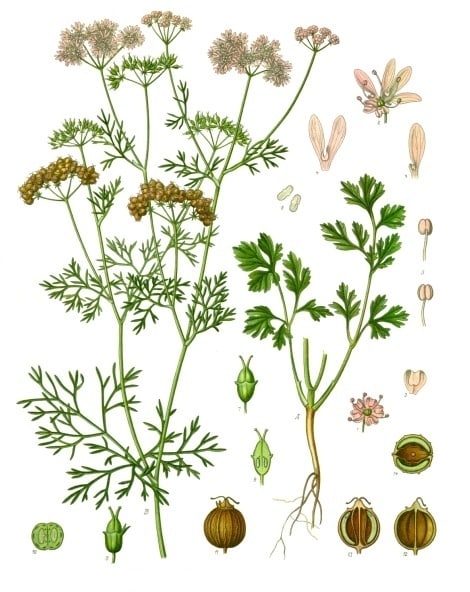
🌿 Morphology
🌞 Growing conditions
🌍 Origin and family
🌾 Uses
Warning: Despite the care taken in writing this sheet, it is essential to cross-reference sources before using or consuming any plant. When in doubt, consult a qualified professional
Permaculture uses
Cilantro leaves and coriander seeds are both edible. The leaves are used fresh in salads and as a garnish. The seeds are used as a spice in various cuisines and have medicinal properties. It attracts beneficial insects like hoverflies and parasitic wasps, aiding in natural pest control in the garden. The plant can be used as a green manure or cover crop to improve soil health. Consider succession planting for a continuous supply of leaves, as it tends to bolt quickly in hot weather. There are slow-bolting cultivars available.
Permapeople description
Coriander, also known as cilantro or Chinese parsley, is a plant native to the Mediterranean region and western Asia. The plant has delicate, fern-like leaves and small, white or pale pink flowers. It grows to a height of about one to three feet, and matures fairly quickly, generally within three to four months.
Coriander can be differentiated from similar plants by its distinctive, fragrant leaves and small, white or pale pink flowers. The plant prefers well-drained soil and full sun, and grows best when watered regularly. It is not winter hardy and should be grown as an annual in most regions.
Coriander is often used as a culinary herb, and the leaves and seeds of the plant are both edible. The leaves have a distinctive, fragrant flavor and can be used fresh or dried in a variety of dishes. The seeds, which are often ground into a powder, have a warm, spicy flavor and are used in many curries and spice blends.
In addition to its culinary uses, coriander has a number of other uses. The plant is said to have medicinal properties, and has been used in traditional medicine to treat a variety of ailments. It is also often used as a natural insect repellent, and some gardeners plant it near other crops to keep pests at bay. The plant is also valued by wildlife, and is a popular source of nectar for bees and other pollinators.
Propagation - Direct sowing
Direct sow in early spring after risk of frost.
Propagation - Transplanting
Avoid transplanting, as cilantro is quick to bolt under any stress.
Links
Botanical description
Coriandrum sativum is an annual herb in the family Apiaceae. All parts of the plant are edible, but the fresh leaves and the dried seeds are the parts most traditionally used in cooking. The leaves are variably shaped, broadly lobed at the base of the plant, and slender and feathery higher on the flowering stems. The flowers are borne in small umbels, white or very pale pink, asymmetrical, with the petals pointing away from the center of the umbel longer than those pointing towards it. The fruit is a globular, dry schizocarp 3–5 mm in diameter. Cilantro grows to 50 cm (20 in) tall.
Companion planting
Cilantro is a good companion plant for many vegetables, including tomatoes, peppers, and brassicas. It repels some pests, such as aphids and potato beetles. Avoid planting near fennel, as it can inhibit cilantro growth.
Propagation methods
Propagation is primarily by seed. Direct sowing is recommended as cilantro does not transplant well. Seeds can be gently crushed to improve germination. It can also self-seed readily in the garden if allowed to go to seed.
History and traditions
Coriander has a long history of use, dating back to ancient Egypt. Seeds were found in the tomb of Tutankhamun. It was also used in ancient Greece and Rome, both for culinary and medicinal purposes. In traditional medicine, it has been used to aid digestion and as an anti-inflammatory agent. It has symbolic associations with love and fertility in some cultures.
Usage calendar
Sow seeds in spring or fall. Harvest leaves throughout the growing season, typically a few weeks after germination. Harvest seeds in late summer or early fall when they turn brown and dry. Flowering occurs in summer. Pruning is generally not required, but removing flower stalks can encourage leaf production for a short time.