
🌿 Morphology
🌞 Growing conditions
🌍 Origin and family
🌾 Uses
Warning: Despite the care taken in writing this sheet, it is essential to cross-reference sources before using or consuming any plant. When in doubt, consult a qualified professional
Permaculture uses
Bristleleaf sedge is primarily used in permaculture for erosion control, particularly on slopes and in riparian areas. Its dense root system helps to stabilize soil. It can also be used as a groundcover in shaded or woodland gardens. While not typically consumed, it provides habitat and food for various insects and small animals, contributing to biodiversity. It's not directly edible or medicinal for humans.
Permapeople description
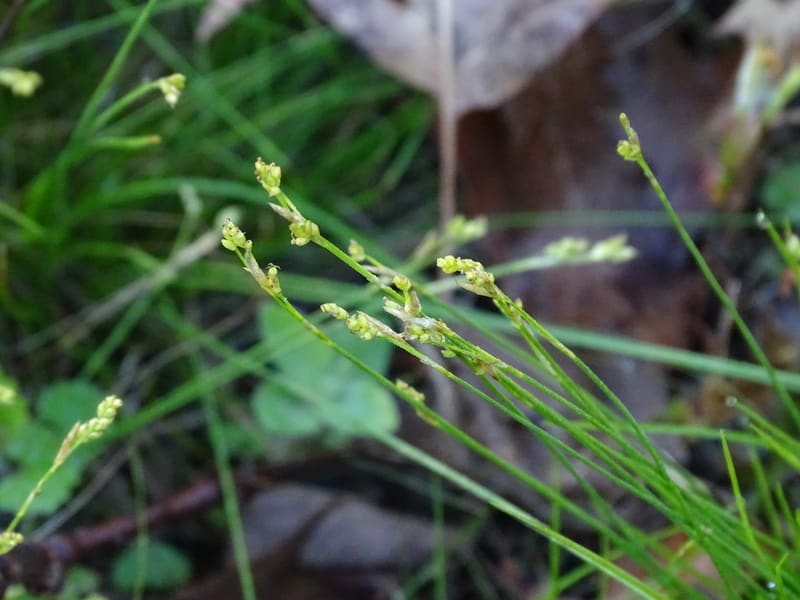
A delicate, tufted sedge with very narrow, white-edged leaves and inconspicuous brown flower spikes.
Botanical description
Carex eburnea is a small, densely tufted, perennial sedge. The culms (stems) are slender, wiry, and triangular in cross-section, typically ranging from 4 to 12 inches tall. The leaves are very narrow, thread-like, and shorter than the culms. The inflorescence consists of a terminal spike, which is usually solitary and contains both male and female flowers (androgynous). The scales are white to pale brown, and the perigynia (sacs enclosing the achenes) are small, ovoid, and green to brown. The achenes (seeds) are lenticular and smooth. It is typically found in dry to moist, calcareous soils, often in shaded or partially shaded habitats such as woodlands, cliffs, and rocky slopes.
Companion planting
Bristleleaf sedge grows well with other shade-tolerant plants such as ferns, woodland wildflowers, and other sedges. It is a good companion plant for trees and shrubs that prefer well-drained, calcareous soils. Avoid planting it with aggressive, competitive plants that might outcompete it for resources.
Propagation methods
Bristleleaf sedge can be propagated by seed or by division. Seed propagation requires cold stratification for several weeks to break dormancy. Division is best done in the spring or fall, separating clumps of the plant and replanting them. It can also spread slowly by rhizomes.
History and traditions
Historically, Carex species have been used by indigenous peoples for weaving baskets, mats, and other crafts. However, specific historical or traditional uses of Carex eburnea are not well-documented. Its primary historical relevance is likely related to its ecological role in maintaining soil stability and providing habitat.
Usage calendar
Flowering occurs in the spring (April-June). Seed production occurs in the summer (June-August). Planting is best done in the spring or fall. Pruning is generally not required, but dead or damaged foliage can be removed as needed.