
Round-headed leek, Round-headed garlic, Drumstick allium
Allium sphaerocephalon
🌿 Morphology
🌞 Growing conditions
🌍 Origin and family
🌾 Uses
Warning: Despite the care taken in writing this sheet, it is essential to cross-reference sources before using or consuming any plant. When in doubt, consult a qualified professional
Permaculture uses
The bulbs and leaves are edible, with a garlic-like flavor, used in salads and cooked dishes. It attracts pollinators and beneficial insects to the garden. Can be used as a cut flower. It naturalizes easily, forming clumps and providing a long season of interest.
Permapeople description
Round-headed leek; a Eurasian and North African species of wild onion
Botanical description
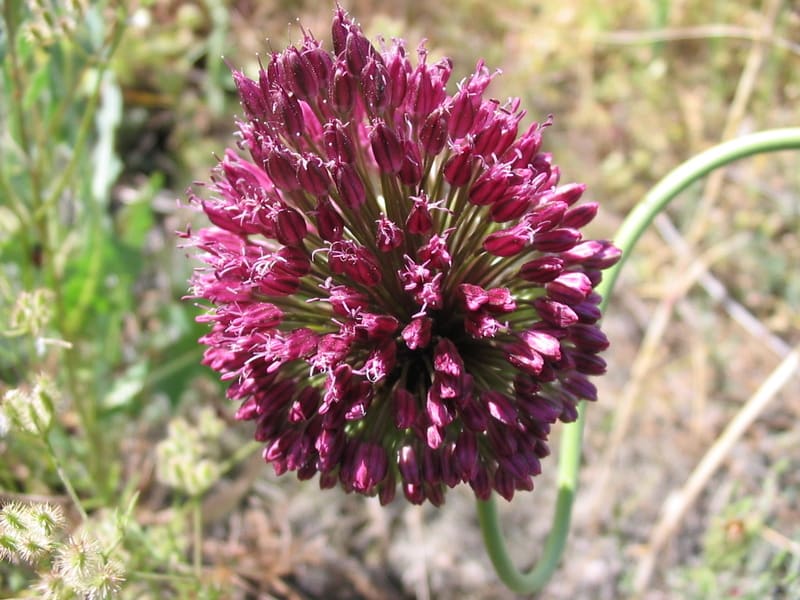
Allium sphaerocephalon is a perennial bulbous plant belonging to the Amaryllidaceae family. It typically grows to a height of 15-80 cm. The plant has cylindrical, hollow leaves. The inflorescence is a dense, spherical umbel composed of numerous small, purplish-red to reddish-purple flowers. The flowers bloom in summer. The bulb is ovoid and about 1-2 cm in diameter. It is native to Europe and Western Asia, and it is found in dry grasslands, meadows, and rocky slopes.
Companion planting
Like other alliums, it may deter pests like aphids, cabbage white butterflies, and carrot root flies. It is a good companion plant for roses, tomatoes, carrots, and chamomile. Avoid planting near beans and peas, as alliums can inhibit their growth.
Propagation methods
Propagation is typically achieved through bulb division in the fall or spring. It can also be propagated by seed, though germination can be slow. Offsets can be carefully separated from the main bulb and replanted.
History and traditions
Historically, Allium species have been used for both culinary and medicinal purposes. While specific historical records for Allium sphaerocephalon are limited, other Allium species have been used traditionally for their purported antiseptic, diuretic, and expectorant properties. They were also used as charms and protective agents against evil spirits.
Usage calendar
Flowering occurs from June to August. Bulbs can be planted in the fall (September-November) or early spring (March-April). Division is best done in fall or early spring. Harvesting leaves can be done sparingly throughout the growing season. Seed collection occurs after flowering.