
Muscadine, Scuppernong, Southern Fox Grape, Bull Grape
Vitis rotundifolia
🌿 Morphology
🌞 Growing conditions
🌍 Origin and family
🌾 Uses
Warning: Despite the care taken in writing this sheet, it is essential to cross-reference sources before using or consuming any plant. When in doubt, consult a qualified professional
Permaculture uses
Muscadines are primarily grown for their fruit, which can be eaten fresh, juiced, or made into wine, jams, and jellies. The thick skins are also edible and contain high levels of antioxidants. The leaves can be used to make tea. The vines provide excellent shade and can be used to create living arbors or trellises. 'Carlos' and 'Noble' are popular cultivars for wine making, while 'Scuppernong' is the original bronze cultivar.
Permapeople description
Muscadine grapes are a species of grape native to the southeastern United States. It has been cultivated for hundreds of years by Native Americans and is notable for its pest and disease resistance.
Publications:
- Muscadine Grapes from NC State Extension
- Muscadine Grapes in the Home Garden from NC State Extension
- The Muscadine Grape (Vitis rotundifolia Michx) from Department of Horticultural Sciences, UF/IFAS Extension
Botanical description
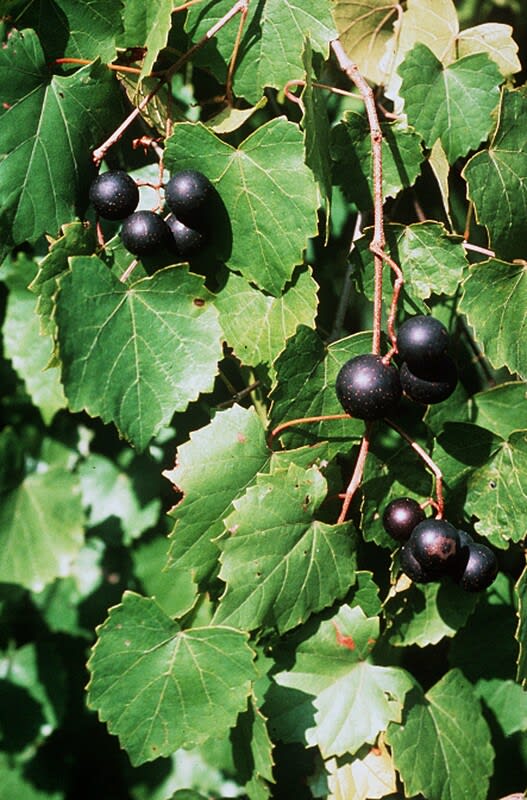
Vitis rotundifolia is a deciduous woody vine native to the Southeastern United States. It is characterized by its round, thick-skinned grapes, which range in color from bronze to dark purple when ripe. The vines are vigorous and can grow to considerable lengths, climbing by means of tendrils. The leaves are simple, alternate, and heart-shaped with coarsely toothed margins. Flowers are small, greenish, and borne in panicles. The bark is dark brown and furrowed. Unlike most other Vitis species, V. rotundifolia has unbranched tendrils and does not shed its bark. It is dioecious, meaning individual plants are either male or female.
Companion planting
Muscadines benefit from a sunny location and well-drained soil. Avoid planting near trees or structures that will cast excessive shade. They can be grown alongside other fruiting plants, such as blueberries or figs, but adequate spacing is essential to allow for vine growth and air circulation. There are no strongly documented companion or repellent relationships.
Propagation methods
Muscadines can be propagated by seed, but cuttings are the most common method to ensure desired cultivar characteristics. Hardwood cuttings taken in the dormant season root well. Layering is also a viable method. Grafting onto disease-resistant rootstock is practiced to improve vigor and disease resistance.
History and traditions
Muscadines have a long history of use by Native American tribes, who consumed the fruit fresh and used the vines for various purposes. European colonists quickly adopted muscadines, recognizing their potential for winemaking. The 'Scuppernong' cultivar, discovered in North Carolina, is considered the oldest grape cultivar in the United States. Muscadines continue to be an important part of Southern culture and cuisine, and are celebrated at local festivals and events.
Usage calendar
Flowering occurs in late spring (April-May). Fruit ripens in late summer to fall (August-October). Planting is best done in late winter or early spring. Pruning is typically done in late winter to early spring while the vines are dormant.